Most auction houses and field businesses do not lose work because they are bad at the craft. They lose it in the gap between "someone got in touch" and "a human replied".
That gap often looks polite. An automatic reply thanks you for your email, asks you to be patient because the inbox is busy, and tells you valuations are by appointment only if you phone the office before you travel. On the surface it is customer service. Underneath it is a system admitting it cannot keep up with demand in real time.
We see that pattern a lot when we talk to salerooms, trades firms and lettings teams. Shared inboxes. Phone diaries. Good people doing their best. Enquiries still slipping away while they wait their turn.
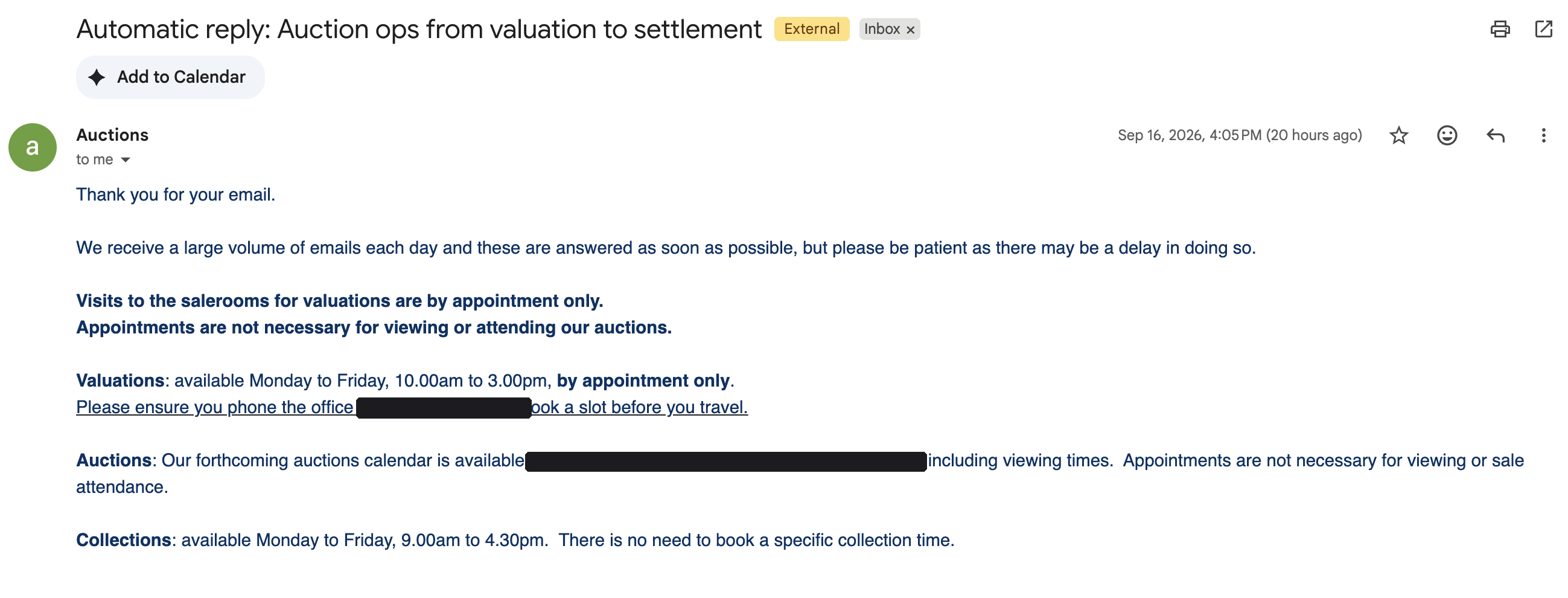
Real saleroom auto-reply. Phone number and website blacked out.
Why minutes matter more than marketing
Inbound interest decays fast. Widely cited sales research on lead response time (InsideSales / XANT, and related Harvard Business Review analysis) keeps pointing at the same shape:
- Contacting an inbound lead within about five minutes is associated with roughly eight times higher conversion than waiting around half an hour.
- Within five minutes you are also on the order of twenty-one times more likely to qualify that lead than if you wait thirty minutes.
- Responding within an hour is about seven times more likely to qualify than waiting another hour, and around sixty times more likely than waiting a full day.
- Plenty of companies still take forty hours or more to make first contact.
You do not need to treat those multipliers as gospel for every sector. The direction is hard to argue with: the people who reply while the enquiry is still hot win more of them. Everyone else is sorting a colder pile.
For an auction house, that is not abstract. A valuation enquiry, a lot question before sale day, a probate call. The sender is comparing options right now. "Please be patient" is not a strategy. It is a holding pattern.
What the auto-reply is really saying
Strip the branding off a typical busy-inbox reply and you get three signals:
- Volume exceeds process. Mail arrives faster than people can triage it by hand.
- The process is still human-first for routing. Phone to book a valuation slot. No structured board that owns who should answer what.
- The firm knows delay is normal. Asking for patience is honesty. It is also a warning light.
None of that means the team is lazy. It usually means the system of record is still an inbox and a diary.
What a better system looks like (without replacing the specialists)
The fix is not a chatbot that fakes expertise. Specialists still value, still answer the hard questions, still decide condition and estimates.
What goes is the sorting: reading which sale or lot a message is about, forwarding it twice, typing the same details into a sheet, losing track of what is still open. An enquiry board that tags, assigns and shows status means someone can reply while the interest is fresh, and the rest of the office can see what is waiting without hunting the shared inbox.
That is the shape of work we do for salerooms. Enquiries in, one owner each, nothing re-typed for the sake of it. The craft stays with people. The queue stops living in hope.
What to do this week
If your auto-reply apologises for delay, treat that as data, not décor.
- Count how many valuation or lot enquiries hit the shared inbox in a sale week.
- Note how long until a named person replies (not the auto-ack).
- Ask whether anyone can see the open list without opening every thread.
If those answers are fuzzy, you already know where the hours go.
We start with a free systems audit. Thirty minutes on how enquiries actually move. You get the jam named, a rough yearly cost, and a fixed-price build if one is worth doing. No requirement to commission anything.
Take the operations check or book an audit if you want that map for your own saleroom or field team.